Experimental
Hardware architecture
Canonical source: openamr-platform-hw/product-architecture.md
Applies to: the documented OpenAMRobot reference mobile base; verify repository revision before changing hardware or firmware.
Experimental project documentation
These instructions describe the current reference build and its measured behavior. Use physical safeguards, test with wheels clear of the floor, and revalidate after changing parts, wiring, firmware, battery chemistry, or geometry.
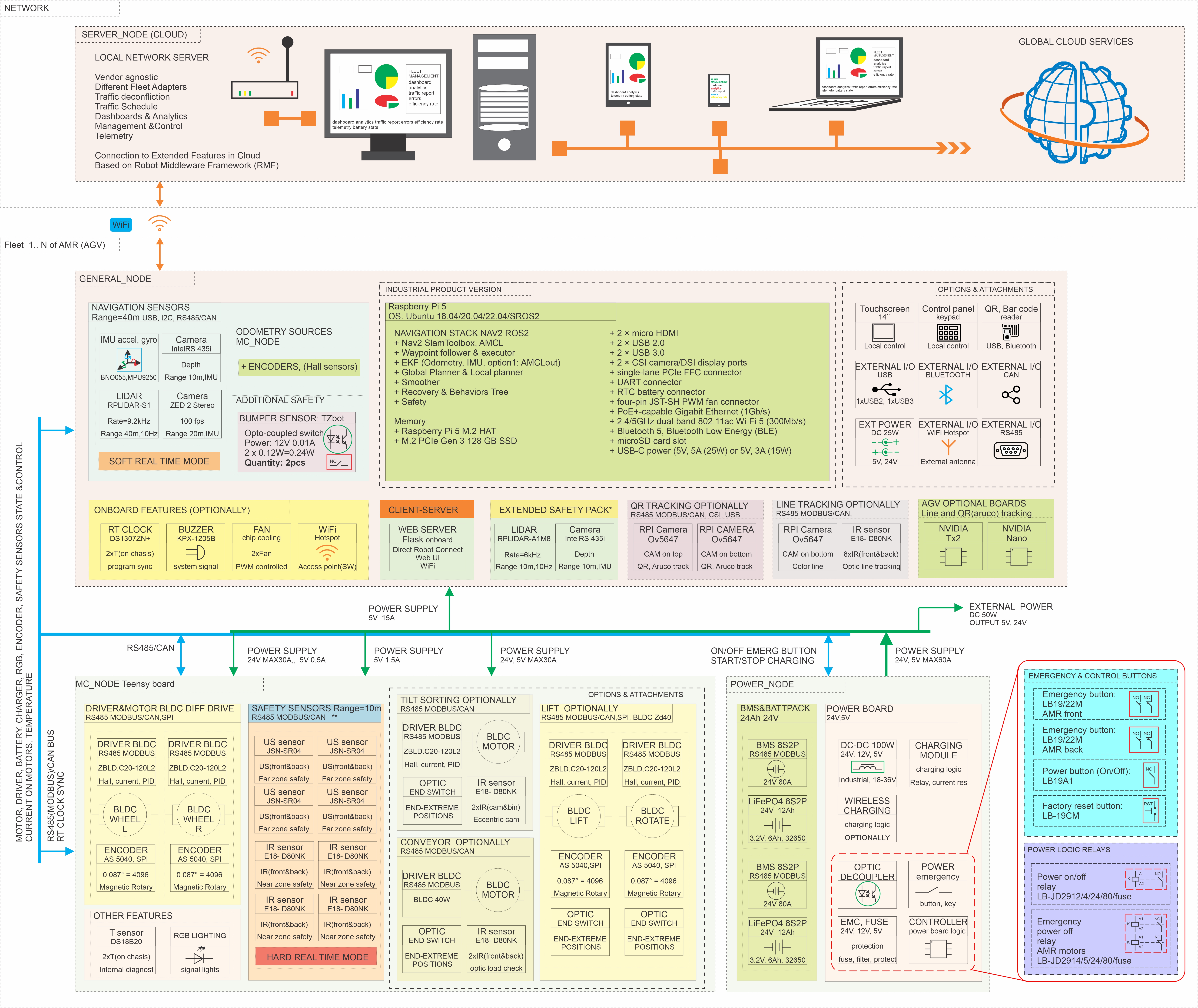
This repository documents the base OpenAMRobot differential-drive platform — the robot that has actually been wired, flashed, and driven. The base is one configuration of a larger product vision (the "industrial product version"): the same chassis and compute, extended with optional attachments and sensor packs.
This page separates the two so nothing here implies the base build ships with a lift, a conveyor, or a wireless charger — it does not.
The full product architecture (superset)
What the base build actually is
The ✅ base (this repo's electrical / firmware / software) is the core of that diagram:
- Drive: 2× BLDC wheels, ZBLD.C20-120L2R drivers, AS5040 magnetic encoders, Teensy 4.0 running micro-ROS motor control (electronics derived from the Linorobot project, motor + controller upgraded to the ZD/ZBLD industrial parts).
- Compute: Raspberry Pi 5 + ROS 2 Jazzy + Nav2.
- Sensing: RPLIDAR A1 (2D), legacy (existing robot); the OpenAMRobot 2.0 LiDAR is the RPLIDAR S3. Pi Camera Module 3, MPU6500 IMU.
- Power: 24 V bus (any chemistry; reference build 2× 12 V; the product targets a LiFePO4 + BMS pack).
What is optional / roadmap (⚙️ NOT on the base build)
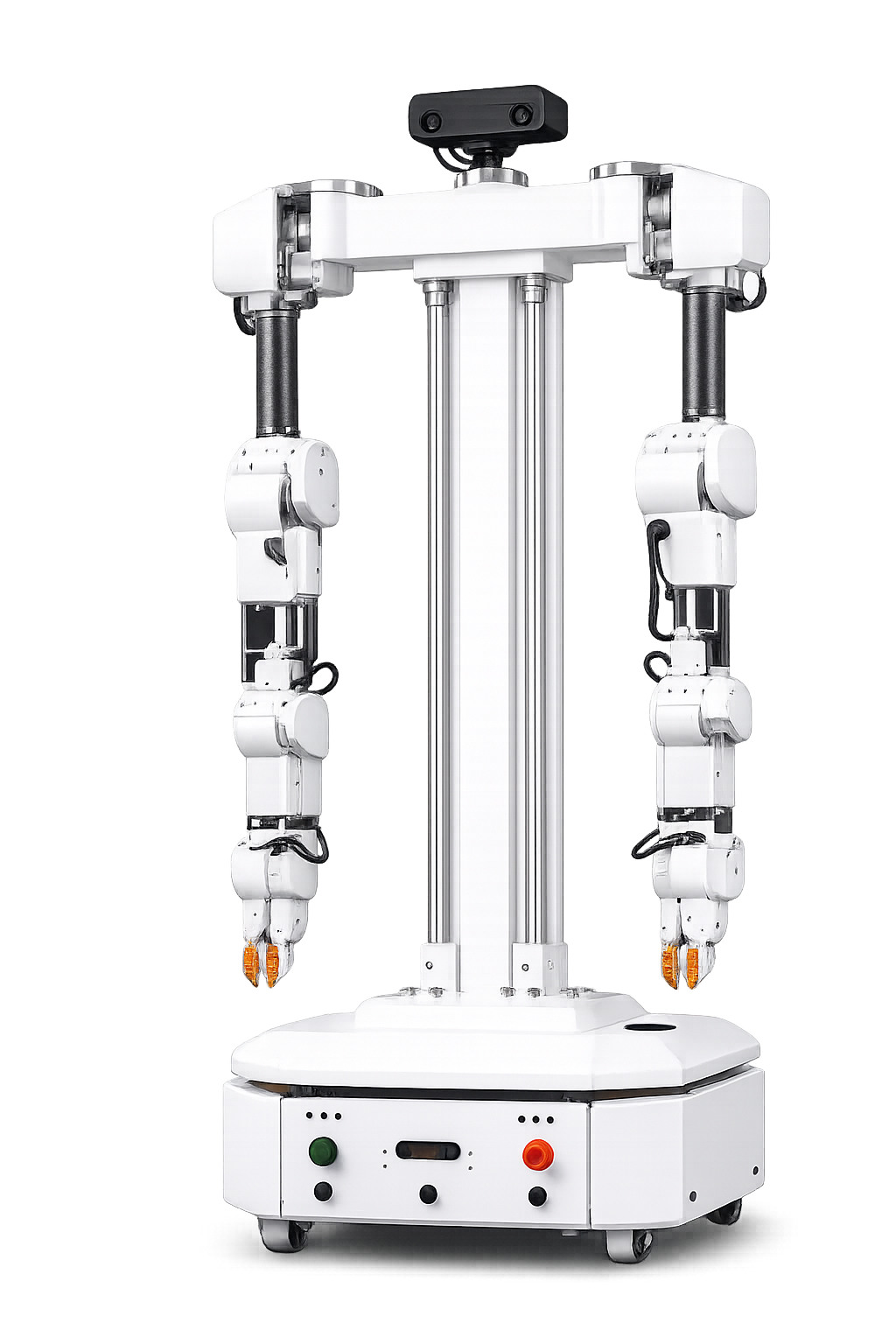
The same base platform, extended toward the full product vision (here with the dual-arm manipulator attachment — illustrative, not the base build):
Shown in the architecture diagram but not part of the base:
- Extra safety pack — ultrasonic (JSN-SR04) + IR (E18-D80NK) proximity rings.
- Attachments — tilt sorting, conveyor, lift (BLDC lift/rotate), end-effectors.
- Charging — wireless charging (WCM-300) with auto-docking.
- Battery/BMS — 24 V smart battery pack + BMS (serial), vs. the base's plain 24 V pack.
- Higher-power drives — ZLTech ZLAC8015D/8030L drivers, hub-motor wheels.
- Tracking / AI — QR + line tracking, on-board NVIDIA (Jetson) for heavier perception.
- Fleet — cloud server, fleet management, dashboards (RMF).
Datasheets for the optional parts are under datasheets/ and clearly marked as options.
Engineering handoff
- Record the repository commit, hardware revision, supply voltage, and test configuration with every result.
- Stop if observed wiring, component labels, geometry, or topic behavior differs from this page; resolve the discrepancy in the owning repository first.
- Report documentation or implementation defects through the repository issue tracker.