Planned
OpenAMRobot 2.0 design
Hardware architecture, general arrangement and stability model of the dual-arm mobile manipulator being designed between 21 September and 20 November 2026.
For: builders, integrators and developers who need to know what the next robot looks like before the hardware exists.
Canonical source: the owning repositories listed below and the OpenAMRobot 2.0 plan set kept by the project leads. This section explains the design and records its status; it does not replace repository files, supplier evidence or the manufacturing release.
Design proposal, not a released robot
Every drawing and number in this section is a design proposal awaiting measured inputs. Nothing here is a build instruction, and no safety claim follows from a diagram being published.
What OpenAMRobot 2.0 is
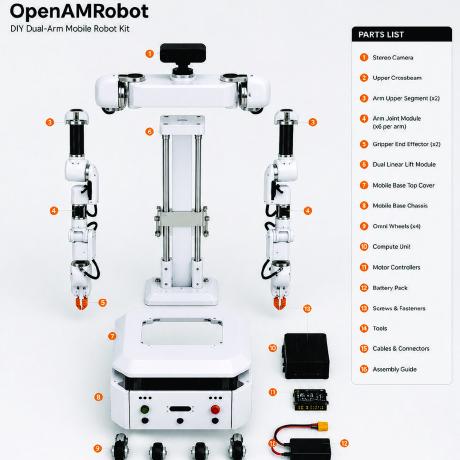
OpenAMRobot 2.0 keeps the existing differential-drive mobile platform and adds a lift column carrying two OpenArm 2.0 arms, an NVIDIA Jetson Orin NX compute module and an STM32-based base controller. The lift column stands on a two-position base plate and moves the shoulder between 1000 and 1350 mm above the floor.
| Area | What this section documents | Owning repository |
|---|---|---|
| Hardware architecture | Connection model of compute, base controller, drives, power, sensors and arms (follows BOM Issue 7.7) | openamr-platform-hw (BOM to be published with the electrical release) |
| General arrangement | Upper-body layout, height stack and configuration IDs; drawings regenerated from the option B CAD | openamr-platform-hw and openamr-upperbody-hw |
| Mass and stability | The F2S stability and stopping model: mass budget, centre of gravity, tipping margins, stopping distance | openamr-platform-hw |
| Arms and manipulation | OpenArm 2.0 integration, device packages, fake-hardware baseline | openamrobot-manipulation |
Decisions recorded so far
Recorded means written in the decision addendum of the plan set (P-03); the revision is given with each decision.
| Decision | Value | Date |
|---|---|---|
| Drivetrain | Two ZLTECH ZLLG80ASM250-L-B hub motors with brakes, one ZLAC8015D V4.2 driver, 200 mm wheels | 21 September 2026 |
| Battery | One 8S1P EVE LF105 LiFePO4 pack, 25.6 V, 105 Ah, Daly 150 A BMS, 20 A charger; battery centred at 25 percent of the robot length from the rear | 28 September 2026, recorded in P-03 revision 18.2 |
| Base camera | Orbbec Gemini 336L, housing centre on the old camera centre, 142.5 mm above the floor, base_camera_link (0.376, 0, 0.0445) from base_link, front-panel opening about 126 x 36 mm; up-tilt bt05, bt10 (baseline) or bt15; two wrist cameras |
12 October 2026, recorded in P-03 revision 19.0 (front-mounted camera first decided 23 September 2026) |
| Upper-body mounting (option B) | DOLD Hexalift V4 lift column, 350 mm stroke (530 mm retracted, 880 mm extended), 240 mm side fore-aft, on a 10 mm aluminium base plate on the 294 mm deck (top face 304 mm) with two column positions, centre (bp000) and +50 mm (bp050); MISUMI HFS6-60120 arm profile, 340 mm, on a 10 mm adapter plate on the column top; OpenArm arm mount point 180 mm ahead of the column axis, y = ±31 mm |
9 October 2026, recorded in P-03 revision 18.9 item 18 |
| Column position | Column axis 330 mm behind the 780 mm chassis front edge: x = +0.060 m from base_link at bp000 and +0.110 m at bp050; OpenArm J1_A mount points at x = +0.240 m and +0.290 m |
12 October 2026, recorded in P-03 revision 19.0 |
| Navigation LiDAR | SLAMTEC RPLIDAR S3 (S3M1-R2) on the existing MMP.07 A1 bracket and 10 mm standoffs with a 7.1 mm spacer plate; beam 222.0 mm above the floor; lidar_link (0.330, 0, 0.124) from base_link, yaw pi |
12 October 2026, recorded in P-03 revision 19.0 items 13 and 19 |
| Near-field sensors | Four MaxBotix MB7060 ultrasonic sensors in the front and rear edge holes (27.5 mm, y = ±0.130 m, 91.4 mm above the floor); two TF-Luna ToF cliff sensors in the front and rear centre holes (22.0 mm; new rear hole); frames us_front_left, us_front_right, us_rear_left, us_rear_right, tof_front, tof_rear |
12 October 2026, recorded in P-03 revision 19.0 |
| IMU | ICM-42688-P on the centreline at x = 0.195 m from base_link, WHO_AM_I 0x47; the MPU6500 is the Gate A unit only |
12 October 2026, recorded in P-03 revision 19.0 |
| BOM issue | OpenAMRobot 2.0 Detailed Hardware BOM, Issue 7.7 | 12 October 2026 |
| Shoulder height | 1000 mm at the retracted lift (304 + 530 + 166) to 1350 mm fully extended (304 + 880 + 166), at the OpenArm arm mount point; lift height is joint state, calibrated stops L1000, L1175, L1350; maximum assembled height 1700 mm (the robot may be lower, never higher; this is not shoulder height) |
9 October 2026, recorded in P-03 revision 18.9 item 18 |
| Head camera | Stereolabs ZED Mini on the lift carriage, lens 22 mm ahead of and 223 mm above the arm mount point, pitch 15 to 35 degrees down in 5 degree steps, baseline 25 degrees | 9 October 2026, recorded in P-03 revision 18.9 item 18 |
| Configuration IDs | Column dold_v4_350, tl3_400; base plate bp000, bp050; head pitch hp15 to hp35; base tilt bt05, bt10, bt15 |
9 October 2026, recorded in P-03 revision 18.9 item 18 |
| Speed | Command ceiling 1.5 m/s, treated as an analytical limit; the accepted operating speed follows from the stability model and the stopping tests | 28 September 2026, recorded in P-03 revision 18.2 |
Inputs still open
- Weighed mass of the existing chassis (the model uses steel volume from CAD).
- ZLTECH data: allowable radial load per motor and the dynamic rating of the brake.
- Hub-motor bracket design and the final track.
- Supplier CAD: lift-column hole patterns, OpenArm J1_A plate outline and the orientation of the chassis deck pattern.
- The stability (F2S) rerun for option B at full lift on both base-plate positions.
- Confirmation that the arms can be supplied without the OpenArm body.
When an input closes, the page that depends on it is updated and its verification date changes.
How to comment
Open a thread in GitHub Discussions or use the feedback link at the bottom of any page. Design decisions are taken by the project leads and recorded in the plan set; a merged documentation page is not itself a decision.