Build robots. Train them for real work.
Learn, build, operate and commercialize a modular ROS 2 platform designed to make robotics useful to domain experts – not only robotics specialists.
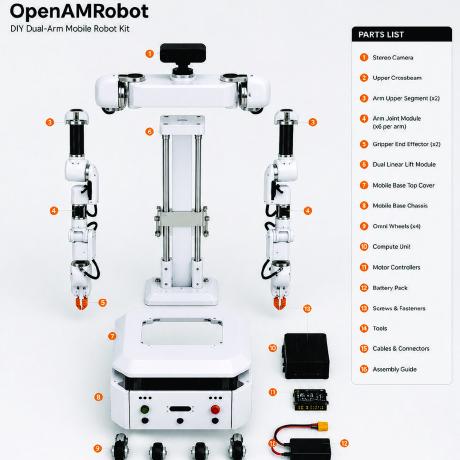
One promise, three doors. Make Embodied AI unprecedentedly simple for domain experts – from reading and assembly to configuration, training, operation and maintenance.
One platform, three doors
GitHub repositories
Canonical code, CAD, firmware, interfaces, releases and exact technical reference.
This knowledge hub
Illustrated concepts and guided paths to build, configure, train, use and maintain the platform.
The App
Guided, semi-automated workflows that hide robotics complexity from domain experts.
Businesses built around it
Training, integration, hardware, pilots, deployment and local support opportunities.
Choose your role
| I want to… | Best starting point | Primary outcome |
|---|---|---|
| Apply task knowledge to run and train a robot | Domain Expert path | Operate missions, demonstrate tasks and judge outcomes safely |
| Learn robotics from the beginning | Beginner path | Understand the platform and complete a first simulation |
| Deploy it at a customer site | Integrator path | Configure and adapt a reliable system |
| Assemble my own platform | Builder path | Build, bring up and accept a working robot |
| Extend code, firmware or hardware | Developer path | Build new capabilities and contribute |
| Create a robotics business | Entrepreneur path | Validate, launch, deliver and support locally |
Two journeys through the ecosystem
Robot ownership
Business building
Current platform
Mobile platform
ROS 2 Jazzy, Nav2, SLAM, navigation, docking, simulation, firmware and open hardware.
Robot interface
Browser-based operation, visualization and no-code workflows.
Upper body & manipulation
Lift, arm-agnostic manipulation, named poses and mobile-manipulation integration.
Demonstration pipeline
Show, Correct, Judge workflows for capturing, replaying and evaluating demonstrations.
Capability status
Pages distinguish stable, beta, experimental, planned, community and partner-supported capabilities. Confirm the relevant repository and release before committing to a deployment.
Software is generally MIT, documentation CC BY 4.0, and hardware source CERN-OHL-P-2.0. Botshare Academy curriculum, certification and partner rights are separate commercial elements.